Adobe Firefly Boards: a new approach to moodboards, concepts and early-stage design
Adobe continues to expand its ecosystem beyond traditional creative tools, and Firefly Boards has become one of the most notable additions in recent years. Introduced globally as part of the Firefly AI initiative, this tool focuses on the earliest stage of creative work — idea generation, visual direction, and collaborative concept building. Instead of switching between multiple applications, designers now have a unified environment where references, AI-generated visuals, and team feedback can coexist from the very beginning of a project.
What Adobe Firefly Boards brings to modern creative workflows
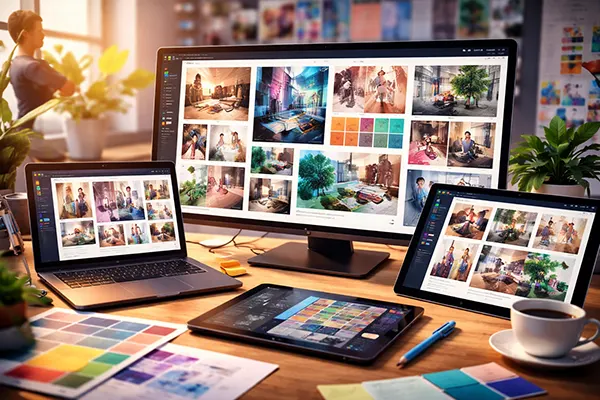
Firefly Boards is designed as an AI-first workspace where ideas can be assembled quickly without the friction typically associated with traditional design software. It allows users to generate images using text prompts, arrange them into visual compositions, and refine directions before any detailed production work begins. This shifts the focus from technical execution to creative exploration.
One of the key aspects is its ability to combine multiple generative models within a single environment. Designers are no longer limited to a single visual interpretation. Instead, they can compare styles, experiment with variations, and build a more nuanced concept board that reflects different creative directions. This is particularly useful in branding, advertising, and product design, where early-stage exploration defines the final outcome.
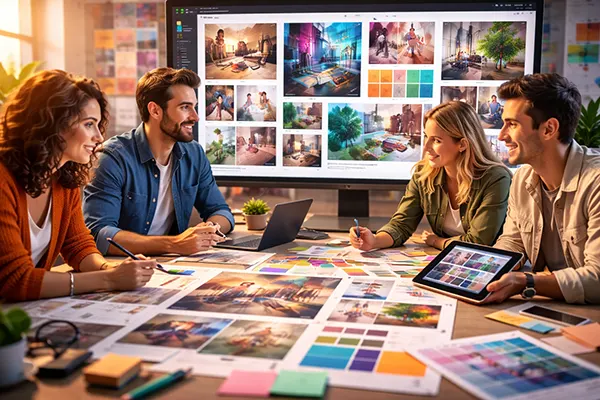
Another important element is real-time collaboration. Teams can work simultaneously on the same board, leaving comments, adjusting layouts, and iterating ideas without exporting files or relying on external tools. This reduces delays and keeps the creative process fluid, especially in distributed teams.
How Firefly Boards differs from traditional moodboards
Traditional moodboards often rely on manually collected references — screenshots, stock images, or previously created assets. Firefly Boards changes this by introducing generative content directly into the ideation process. Instead of searching for the right reference, designers can create it instantly based on a concept or keyword.
This approach significantly speeds up early-stage design. For example, instead of browsing dozens of sources to find a suitable visual style, a designer can generate multiple variations in seconds and refine them based on feedback. The process becomes iterative rather than linear.
Additionally, Firefly Boards integrates more seamlessly with other Adobe tools compared to static moodboards. Concepts developed within the board can later be transferred into Photoshop, Illustrator, or other applications for detailed execution, maintaining consistency throughout the workflow.
Key features and practical use cases in 2026
As of 2026, Firefly Boards has evolved into a practical tool used across multiple industries. One of its core features is prompt-based image generation with style control. Users can define tone, lighting, composition, and artistic direction, allowing for precise visual experimentation even without advanced design skills.
Another notable feature is layout flexibility. Boards are not restricted to rigid grids; instead, users can organise elements freely, creating dynamic compositions that reflect real creative thinking rather than predefined templates. This makes the tool suitable for concept art, campaign planning, and UX direction.
Firefly Boards is also increasingly used in cross-functional teams. Marketers, product managers, and designers can collaborate on the same visual space, aligning expectations early in the process. This reduces misunderstandings later in production and improves overall efficiency.
Real-world scenarios where Firefly Boards is effective
In branding projects, Firefly Boards allows teams to explore multiple visual identities before committing to a final direction. Colour palettes, typography ideas, and imagery styles can be tested quickly, providing a clearer foundation for further design work.
In advertising, agencies use the tool to develop campaign concepts. Instead of presenting abstract ideas, teams can visualise scenes, compositions, and moods using AI-generated assets, making client communication more concrete and easier to understand.
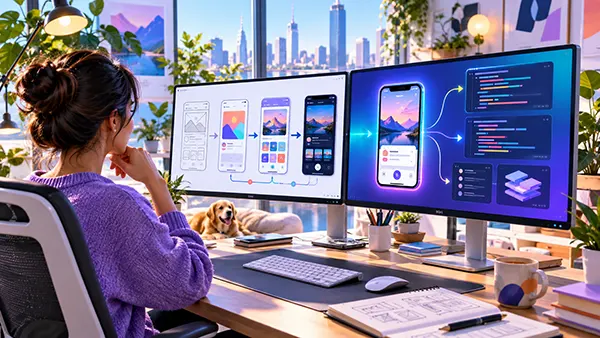
Product teams also benefit from Firefly Boards when working on early UX concepts. By combining interface sketches with generated visuals, they can present a more complete vision of the user experience before moving into prototyping tools.
Advantages, limitations, and future outlook
One of the main advantages of Firefly Boards is speed. It reduces the time required to move from an idea to a visual concept, which is particularly valuable in fast-paced environments. The integration with Adobe’s ecosystem also ensures that work can continue seamlessly across different stages of production.
Another strength is accessibility. The tool lowers the barrier for non-designers to participate in creative discussions. By using simple prompts, stakeholders can contribute ideas visually rather than relying solely on verbal descriptions.
However, there are still limitations. AI-generated visuals may lack precision for detailed design tasks, and not all outputs are immediately usable without refinement. Designers still need to apply critical judgement and adapt generated content to meet professional standards.
What to expect from Firefly Boards in the near future
Looking ahead, Adobe is likely to expand integration between Firefly Boards and its core applications. This could include deeper synchronisation with Photoshop layers, Illustrator vectors, and even video tools like Premiere Pro, allowing ideas to transition more smoothly into production.
Another expected development is improved control over generative outputs. As models become more advanced, designers will gain more precise control over composition, style consistency, and brand alignment, making the tool more reliable for professional use.
Firefly Boards is also likely to play a central role in collaborative design environments. With remote work continuing to shape creative industries, tools that combine ideation, communication, and execution in one place will become increasingly important.